Welcome: Laizhou Machinery Group



When Australian caravan dealers evaluate a new manufacturing partner, price is often one of the first topics discussed. However, experienced importers know that production lead time can have just as much impact on business success.
A competitive quotation means very little if production cannot be completed according to the dealer's sales schedule.
Understanding how manufacturers manage production planning helps dealers make better purchasing decisions and reduce delivery risks.
Many caravan dealerships plan their inventory months in advance.
Production delays may affect:
Seasonal sales
Marketing campaigns
Customer delivery dates
Cash flow
Demonstration events
Dealer reputation
Reliable delivery is often more valuable than a slightly lower purchase price.
Every manufacturer has a normal production cycle.
Dealers should understand:
Standard production lead time
Busy season capacity
Holiday schedules
Material procurement time
Quality inspection period
These factors all influence the final delivery schedule.

Production lead time depends partly on factory capacity.
Questions dealers may ask include:
How many caravans can be produced each month?
Are multiple production lines available?
How are OEM orders scheduled?
How is production managed during peak seasons?
The objective is not simply to find the largest factory, but to understand whether production capacity matches future business plans.
Customized caravans generally require additional preparation.
Examples include:
New layouts
Different electrical systems
Custom graphics
Interior modifications
Private-label branding
Dealers should allow sufficient time for engineering confirmation before production begins.
Certain components may have different procurement times.
These can include:
Appliances
Lithium batteries
Solar equipment
Air-conditioning systems
Imported accessories
Special interior materials
Confirming component availability before production starts helps reduce unexpected delays.
Production updates provide confidence throughout the manufacturing process.
Many dealers appreciate receiving:
Assembly photographs
Production videos
Progress reports
Quality inspection updates
Packing confirmation
Regular communication helps dealers prepare for shipping and customer delivery.
Very short production promises are not always a positive sign.
Dealers should consider whether the proposed schedule allows sufficient time for:
Manufacturing
Testing
Quality inspection
Packaging
Export preparation
Reliable production planning is usually more valuable than unrealistic delivery commitments.
Successful dealers often place repeat orders before inventory is completely sold.
This approach helps:
Maintain product availability
Reduce waiting time
Improve production scheduling
Build stronger supplier relationships
Long-term planning benefits both the dealer and the manufacturer.
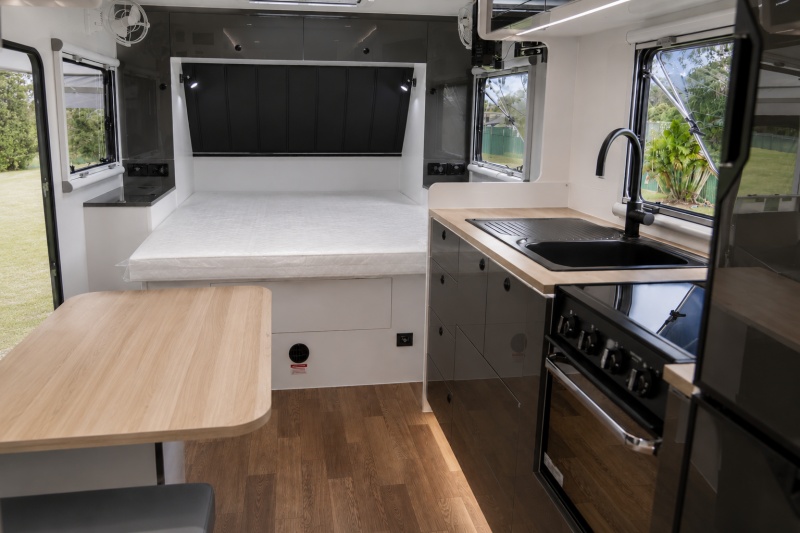
A manufacturer that consistently delivers according to schedule helps dealers:
Improve customer satisfaction
Plan promotions
Reduce inventory uncertainty
Strengthen market reputation
Consistency often creates more business value than simply producing faster.
LZM cooperates with caravan dealers, importers, and OEM brands worldwide.
We support:
Production planning
OEM projects
Customized layouts
Different caravan sizes
Technical communication
Long-term manufacturing cooperation
Our goal is to help dealers develop reliable products while maintaining efficient production schedules.
Explore the complete LZM Off Road Caravan range:
https://www.lgloader.com/list/54-chinese-china-off-road-caravan.html
The LZM 21ft Family Off Road Caravan is designed for dealers seeking a balance between family comfort, off-road capability, and flexible customization.
Different layouts, equipment packages, and branding options can be discussed according to project requirements.
Learn more:
https://www.lgloader.com/products/285-21ft-Off-Road-Caravan-For-Sale.html
Production lead time is an important factor when selecting an off road caravan manufacturer.
Australian dealers who understand production planning, factory capacity, material availability, and communication processes are better prepared to build stable supply chains and serve their customers successfully.
Rather than focusing only on the lowest quotation, evaluating production reliability helps create stronger long-term business partnerships.