Welcome: Laizhou Machinery Group



Suspension is one of the most important technical areas Australian caravan dealers evaluate when sourcing off road caravans.
Customers may compare kitchens, batteries, layouts and interior finishes first, but the suspension system has a major influence on how a caravan behaves when travelling over corrugated roads, gravel tracks and uneven terrain.
For dealers importing caravans or developing a private-label range, the objective should not simply be to select the most expensive suspension available. The suspension needs to match the caravan's weight, intended terrain and target customer.
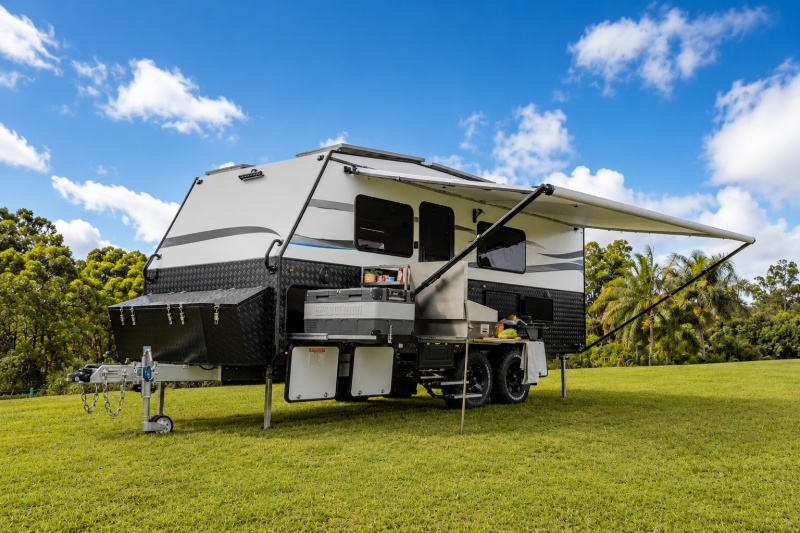
Not every caravan marketed as an off road caravan will be used under the same conditions.
Some customers mainly travel on:
Sealed highways
Caravan parks
Maintained gravel roads
Others may regularly encounter:
Corrugated roads
Rough tracks
Remote camping areas
Uneven surfaces
Long-distance outback travel
Dealers should therefore define the intended use before confirming the suspension configuration with the manufacturer.
Suspension selection should be considered together with the overall caravan design.
Important factors can include:
Caravan tare weight
Expected payload
Water capacity
Battery configuration
Appliances
Storage
Optional equipment
Adding batteries, water tanks and accessories can significantly change the operating weight of a caravan.
This is why suspension should not be selected independently from the complete vehicle specification.
Independent suspension is commonly considered for off road caravan applications because the movement of one wheel can be less directly dependent on the movement of the opposite wheel.
Depending on the system design, this can be beneficial when travelling across uneven terrain.
However, simply advertising "independent suspension" does not tell a dealer everything about the system.
Dealers should also understand its:
Rated capacity
Construction
Shock absorber arrangement
Bushes and joints
Adjustment requirements
Replacement parts
Selecting a suspension system with an appropriate load rating is important.
The dealer and manufacturer should consider the complete caravan configuration rather than simply selecting a suspension based on caravan length.
For example, two 21ft caravans may have very different operating weights if one has:
Larger water tanks
More lithium batteries
Additional solar equipment
External storage
Extra appliances
Therefore, caravan size alone should not determine suspension selection.
Larger off road caravans frequently use tandem axle configurations.
Depending on the design, potential advantages can include:
Load distribution
Stability
Suitability for heavier caravans
Additional support for larger layouts
But tandem axle systems also add components, weight and maintenance considerations.
Dealers should evaluate them as part of the complete caravan design rather than assuming that more axles automatically mean a better caravan.
Shock absorbers help control suspension movement.
For caravans travelling over repeated uneven surfaces, suitable damping can contribute to:
Better ride control
Reduced excessive movement
Improved stability
Protection of interior equipment
The suspension and shock absorber system should therefore be considered together.
For Australian dealers, performance is only one consideration.
Maintenance matters as well.
Before choosing a suspension configuration, dealers should discuss:
Replacement bushes
Bearings
Shock absorbers
Suspension arms
Fasteners
Other service components
A sophisticated system is less attractive if replacement parts become difficult to obtain.
When importing caravans from overseas, dealers should consider which suspension components should be kept locally.
A practical spare-parts strategy can reduce downtime if a customer requires service.
For repeat orders, dealers can discuss suitable spare parts with the manufacturer according to the suspension configuration being supplied.
Suspension should never be evaluated in isolation.
The chassis, axle position, suspension mounting points, water tanks, batteries and major equipment all influence the overall design.
Good engineering requires these components to work as a complete system.
This is particularly important when developing customized OEM caravans.
Not every dealer serves the same customer.
A dealer focused on touring customers may require one configuration, while a brand targeting more demanding off road applications may prefer another.
OEM projects can therefore involve discussions about:
Caravan weight
Intended terrain
Axle configuration
Suspension capacity
Shock absorbers
Wheel and tyre specifications
Ground clearance
Final configurations should be evaluated according to the complete project requirements.
Before confirming an order, useful questions include:
What suspension configuration is proposed?
What load rating is it designed for?
Why is this system suitable for this caravan?
Which replacement components are required?
Are spare parts available?
Can the suspension specification be changed for different models?
How does the suspension integrate with the chassis?
These questions provide more useful information than simply asking:
"Does this caravan have off road suspension?"
Large shock absorbers and heavy suspension components can look impressive in photographs.
But professional dealers should evaluate engineering suitability rather than appearance alone.
The best suspension is not necessarily the largest or most expensive system.
It is the system that appropriately matches:
caravan weight + intended terrain + chassis design + customer use.
Explore different LZM Off Road Caravan models and configurations:
https://www.lgloader.com/list/54-chinese-china-off-road-caravan.html
The LZM 21ft Family Off Road Caravan can be customized according to different dealer and market requirements.
In addition to suspension-related specifications, LZM can discuss different layouts, electrical systems, batteries, solar packages, interior configurations and OEM branding for international partners.
Product details:
https://www.lgloader.com/products/285-21ft-Off-Road-Caravan-For-Sale.html
For Australian caravan dealers, choosing an off road suspension system should not be reduced to a single specification or marketing label.
Caravan weight, terrain, chassis design, load requirements, maintenance and spare-parts availability should all be considered before production.
Dealers working directly with a manufacturer can discuss these factors during product development and select a configuration appropriate for their target market.