Welcome: Laizhou Machinery Group



For a caravan dealer or importer, finding a supplier in China is relatively easy.
Finding a manufacturer suitable for a long-term dealer program is more difficult.
A retail buyer may purchase one caravan and focus primarily on price, layout and personal preferences. A dealer needs to consider what happens after the first order.
Can the same caravan be produced again?
Can specifications remain consistent?
Can the manufacturer support OEM branding?
Can spare parts be supplied?
Can the dealer develop several models around the same manufacturing platform?
These questions are particularly important when evaluating a China off road caravan manufacturer for wholesale or distribution.
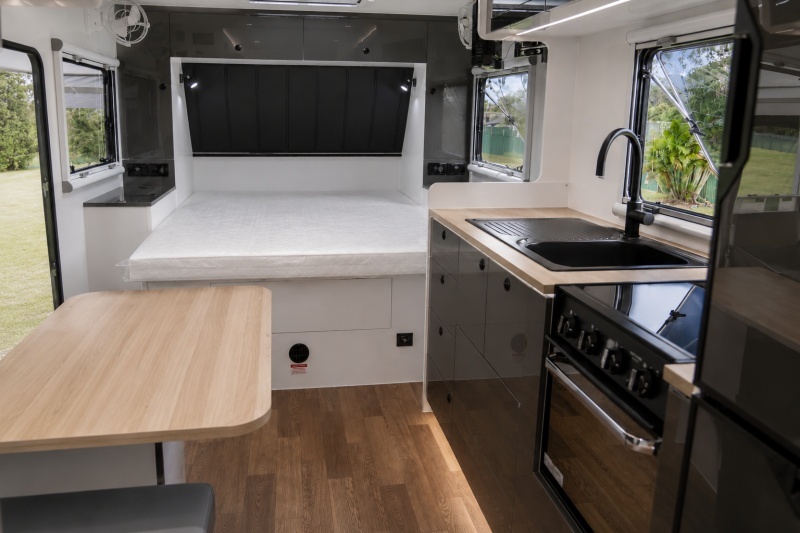
The first caravan is only the beginning of a dealer relationship.
If the model performs well in the local market, the importer may need:
Additional units
Different caravan sizes
Alternative layouts
Standard and premium configurations
Spare parts
Updated components
Dealer branding
This means supplier selection should consider the manufacturer's ability to support a repeatable product range, not simply produce one attractive sample.
International buyers searching for Chinese caravans may encounter many types of suppliers.
Some focus primarily on exporting existing products.
Others can participate more directly in:
Product specification
OEM configuration
Interior layout
Electrical systems
Water systems
Suspension
Dealer branding
Repeat production
For dealers, the important question is not simply whether a company calls itself a manufacturer.
The importer should determine what manufacturing and technical capabilities are actually available for the project.
A dealer does not always need to design a completely new caravan.
Existing platforms can provide a practical starting point.
The dealer can then evaluate:
Caravan length
Sleeping capacity
Interior layout
Bathroom
Kitchen
Storage
Suspension
Battery system
Solar capacity
Water capacity
Starting with an existing model can reduce development complexity and make future repeat orders easier.
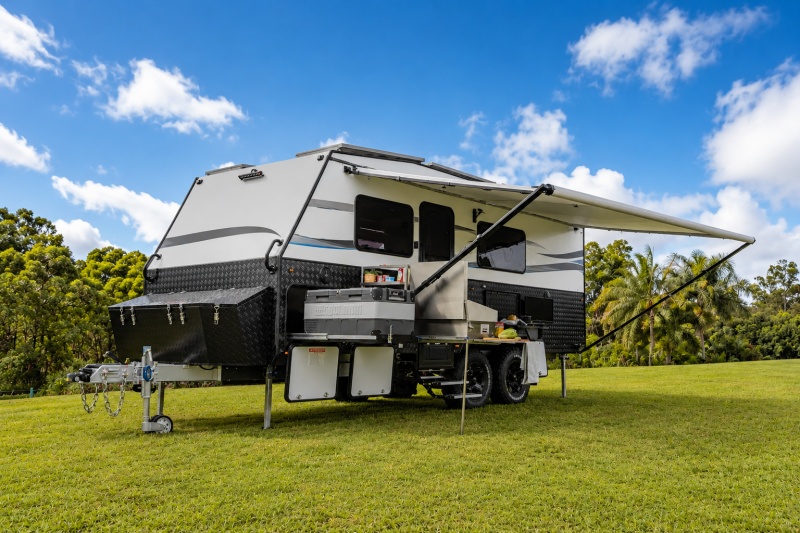
OEM customization is valuable when it helps the dealer create a product suited to the local market.
Useful customization may include:
Dealer logo
Exterior graphics
Interior colours
Upholstery
Equipment packages
Battery capacity
Solar capacity
Selected appliances
Layout adjustments
But customization should not become an objective by itself.
Every unique component can increase:
Production complexity
Spare-parts requirements
After-sales difficulty
Future sourcing risk
For dealer programs, controlled customization is usually more practical than unlimited customization.
Many importers prefer to develop their own caravan brand.
A private-label project may involve:
Dealer logo
Model names
Exterior decals
Interior branding
Product documentation
Selected specifications
This allows the dealer to build local brand recognition rather than simply reselling a generic factory product.
However, branding works best when the underlying product specification is stable.
Customers buying the same model in different production years should not unexpectedly receive substantially different components without a clear reason.
With one caravan, a component difference may seem insignificant.
With dozens of caravans in the market, inconsistency becomes an after-sales problem.
Imagine the same model being supplied with several different:
Water pumps
Inverters
Batteries
Lighting components
Plumbing fittings
Appliances
The dealer then needs to identify which component is installed in each customer's caravan before providing service.
For this reason, repeat production should aim for reasonable component consistency.
Manufacturers sometimes need to change components because:
A supplier stops production
Availability changes
A component is upgraded
Lead times become excessive
This is normal in manufacturing.
The important issue for a dealer is change control.
Major substitutions should be communicated where they materially affect the agreed specification.
This helps the dealer maintain:
Accurate product information
Spare-parts records
Customer expectations
Service procedures
One way to simplify wholesale purchasing is to establish several configurations.
For example:
Focused on the equipment required by mainstream touring customers.
Adds greater battery capacity, solar charging and related equipment.
Adds selected comfort and equipment upgrades for a higher retail price position.
This allows the dealer to offer customer choice without creating a completely different caravan for every order.
A dealer product range should have a logical structure.
Smaller models may target:
Couples
Shorter trips
Customers preferring compact towing dimensions
Mid-size caravans may provide additional living space while remaining relatively manageable.
Larger models can target:
Families
Longer trips
Greater storage requirements
More comprehensive equipment
The manufacturer should therefore be able to discuss not only individual caravans but also how several models can form a dealer product range.
A dealer quotation should eventually become a clear production specification.
Depending on the caravan, this may include:
Chassis
Suspension
Wheels and tyres
Braking equipment
Body construction
Electrical system
Battery capacity
Solar system
Water tanks
Plumbing
Appliances
Interior layout
Optional equipment
The clearer the approved specification, the easier it becomes to inspect the finished caravan.
Large battery and solar numbers can look impressive on a product page.
But dealers should consider actual customer requirements.
Electrical configuration depends on expected loads such as:
Refrigerator
Lighting
Water pump
Electronics
Cooking equipment
Air conditioning where applicable
The manufacturer and dealer should consider battery storage, charging and consumption as one system.
This creates a more useful product than simply installing the largest components available.
Large freshwater tanks can be valuable for remote travel.
But water adds significant weight.
Approximately one litre of water has a mass of one kilogram.
Therefore, water capacity should be considered together with:
Number of occupants
Expected trip duration
Refill availability
Payload
Weight distribution
For dealer projects, a specification that looks impressive on paper may not always be the most commercially practical configuration.
An off road caravan is not defined simply by the appearance of its suspension.
Running equipment should be considered according to factors such as:
Final caravan mass
Intended terrain
Axle configuration
Ground clearance
Wheel and tyre specification
If a dealer significantly increases batteries, water capacity or other heavy equipment, those changes should be considered in the overall vehicle specification.
Factory inspection is more effective when there is a clear reference specification.
Before shipment, relevant checks may include:
Exterior condition
Interior finish
Doors and windows
Electrical equipment
Plumbing
Appliances
Chassis equipment
Wheels and tyres
Ordered options
Dealer branding
The objective is not only to identify defects.
It is also to confirm that the caravan matches what the dealer actually ordered.
Producing one carefully prepared sample is not the same as supporting a dealer.
A successful supplier relationship requires the ability to reproduce the approved model.
For repeat orders, dealers should pay attention to:
Specification consistency
Component consistency
Production communication
Quality control
Documentation
Spare parts
This becomes increasingly important as the dealer's installed customer base grows.
Dealers should not wait for the first customer failure before asking where replacement parts can be obtained.
During product development, components can be divided into two broad categories:
Parts that can reasonably be sourced locally
and
parts that need factory support.
This helps the dealer decide which spare components should be stocked.
Common service areas may include:
Electrical components
Plumbing components
Seals
Hardware
Lighting
Running equipment
A good wholesale program considers the product's complete service life.
Warranty is important, but dealers should understand the actual process.
Questions may include:
What is covered?
What information is required for a claim?
How are replacement parts supplied?
Who provides technical information?
What happens after the warranty period?
A written warranty statement is useful, but practical communication and spare-parts support are equally important for a distributor.
Chinese manufacturing specifications do not automatically satisfy every destination market.
Requirements may differ for:
Electrical equipment
Braking
Coupling
Lighting
Gas systems
Dimensions
Weight
Registration
The importer should identify applicable requirements before production and obtain appropriate local professional or regulatory advice where necessary.
This is much more efficient than discovering major compatibility issues after the caravans arrive.
When comparing Chinese caravan manufacturers, dealers may receive quotations with significant price differences.
But two quotations may not represent the same product.
Differences can exist in:
Suspension
Batteries
Solar
Appliances
Water capacity
Body construction
Interior materials
Optional equipment
A meaningful supplier comparison therefore needs to consider:
specification + manufacturing + support + price
rather than price alone.
Before selecting a long-term supplier, dealers and importers should ask:
Which off road caravan models do you manufacture?
Can models be supplied for repeat dealer orders?
What OEM customization is available?
Can we use our own caravan brand?
Which major components are standardized?
How are component substitutions handled?
What quality-control process is used?
Can inspection be completed before shipment?
What spare parts are available?
What warranty support is provided?
Can different equipment packages be standardized?
What production lead time should dealers expect?
What is the minimum purchasing quantity?
Can the same specification be reproduced for future orders?
The answers help determine whether a supplier is suitable for a long-term wholesale relationship.
LZM supplies off road caravan products for international dealers, distributors and importers.
Businesses evaluating a long-term supplier can review the China Off Road Caravan Manufacturer range to compare available caravan models and discuss OEM requirements.
Dealer projects can be developed around existing platforms with selected customization for:
Branding
Layout
Electrical equipment
Water systems
Interior specifications
Market-specific requirements
The objective is to establish a product specification that can support repeat purchasing rather than redesigning every caravan from the beginning.
For importers planning to distribute multiple caravan models, the first discussion should focus on the intended product range rather than only one unit.
Useful information includes:
Destination market
Existing caravan business
Target customer groups
Required caravan sizes
Preferred layouts
Equipment level
OEM branding
Initial purchasing quantity
Expected future volume
LZM can then discuss which existing platforms may be appropriate for the dealer program.
The best China caravan manufacturer for a dealer is not necessarily the supplier offering the largest number of options or the lowest initial quotation.
For a long-term importer, the more important capabilities are repeat production, controlled specifications, OEM support, quality consistency, spare-parts availability and technical communication.
A dealer needs a caravan that can be sold today—and a manufacturing platform that can still be ordered and supported as the local business grows.
That is the difference between purchasing a caravan and developing a sustainable wholesale caravan supply program.