Welcome: Laizhou Machinery Group



For a caravan dealer, adding more models does not automatically create a stronger product range.
Two caravans that are close in size can easily compete with each other if they have similar layouts, equipment and retail positioning.
This is particularly relevant when comparing a 17ft off road caravan with a 19ft off road caravan.
The two-foot difference may appear relatively small, but it can influence:
Interior layout
Sleeping arrangements
Bathroom space
Kitchen size
Storage
Water capacity
Battery installation
Overall weight
Target customer
Retail price positioning
For dealers and importers, the important question is therefore not simply:
Which caravan is bigger?
A better question is:
Do the 17ft and 19ft models serve sufficiently different customers to justify carrying both?
A 17ft platform can occupy an important position between compact caravans and larger family models.
Depending on the configuration, it may appeal to:
Couples
Two-person touring customers
Small families
Buyers wanting manageable caravan dimensions
Customers who do not require a large family layout
For a dealer, the commercial advantage can be a balance between interior functionality and overall caravan size.
Rather than trying to install every available feature, the 17ft model can be positioned around a clear customer profile.
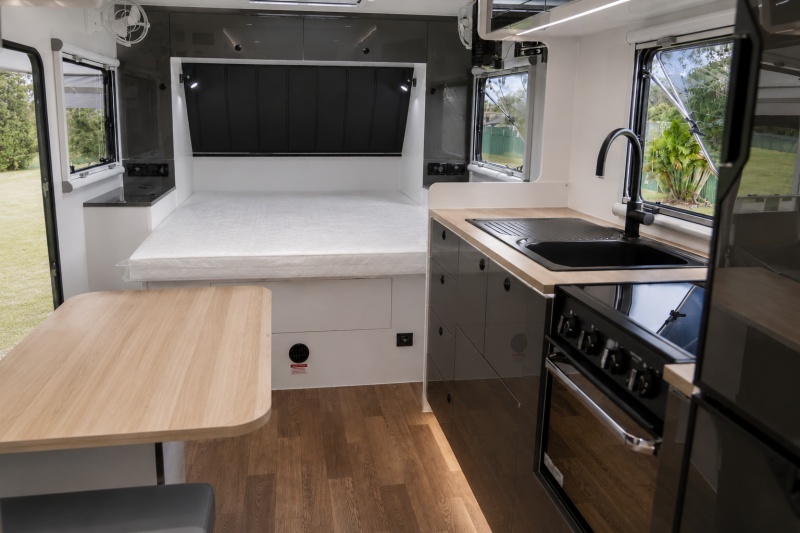
The additional length of a 19ft platform can create more flexibility for interior planning.
Depending on the design, the extra space may be used for:
Larger bathroom
Additional storage
Larger kitchen
More comfortable seating
Alternative sleeping arrangements
Family-oriented layout
However, the extra space should have a purpose.
If the 19ft model simply uses the same layout as the 17ft caravan with slightly more empty floor area, customers may not perceive enough additional value.
If both models are offered, customers should be able to understand why they would pay more for the larger caravan.
For example:
17ft Model
Compact touring platform focused on couples or smaller travelling groups.
19ft Model
Larger touring platform offering additional interior space, storage or family functionality.
The exact positioning will vary by market.
The principle is that each model needs a commercial reason to exist.
Length is easy to advertise, but it is not enough to build a product range.
Customers are more likely to understand differences based on practical benefits such as:
Sleeping capacity
Bathroom arrangement
Storage
Kitchen space
Off-grid capability
Equipment package
Dealers should therefore decide what the larger model actually provides beyond an additional two feet.
One possible way to differentiate the models is through occupancy.
For example, depending on available layouts:
17ft: primarily couples / smaller travelling groups.
19ft: couples wanting additional comfort or families requiring greater sleeping capacity.
This does not mean every 19ft caravan must have more beds.
A larger model can also target two people who simply want more space.
The important point is to define the customer before confirming the layout.
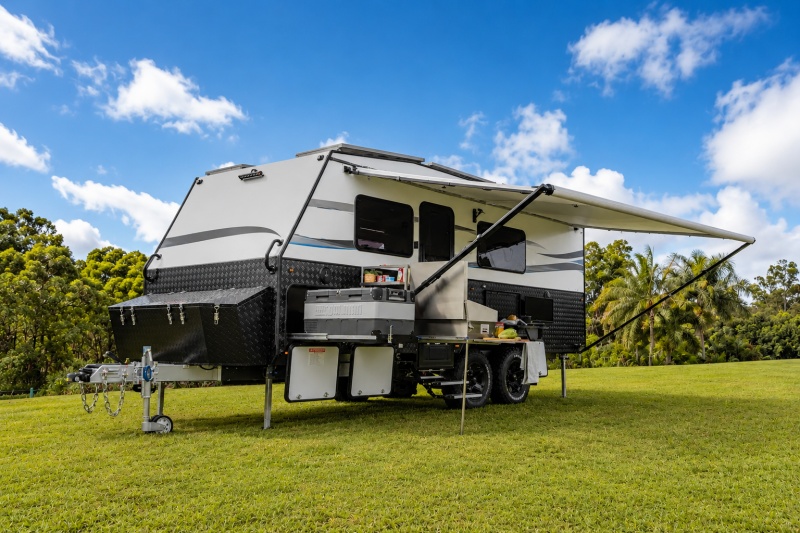
A permanent bed provides convenience but consumes a substantial part of the caravan interior.
In a 17ft model, this can place greater pressure on:
Dining space
Bathroom
Kitchen
Storage
A 19ft platform may provide more flexibility around the same permanent sleeping arrangement.
Dealers should compare the usable interior layout, not simply the external caravan length.
Bathroom configuration often has a significant effect on customer perception.
Possible designs can include:
Combined shower and toilet
Larger combined bathroom
Separate areas, where the layout permits
Additional storage
A compact bathroom may be acceptable in a smaller touring model.
Customers moving to a larger and more expensive caravan may expect additional bathroom comfort.
This can help establish a clearer distinction between 17ft and 19ft models.
A larger caravan provides the opportunity for a larger kitchen, but that is not automatically necessary.
Dealers should consider whether customers are likely to:
Cook mainly inside
Cook mainly outside
Use both
Travel for extended periods
Stay primarily at serviced campsites
A 19ft caravan could use its extra space for the kitchen—or the dealer may decide that storage and living space are more commercially valuable.
Additional storage can be particularly valuable for longer trips.
Customers may need space for:
Clothing
Bedding
Food
Outdoor furniture
Camping equipment
Tools
Personal items
Storage can be created through:
Overhead cabinets
Under-bed areas
Wardrobes
Kitchen cabinetry
Exterior compartments
For dealers, storage is easy for customers to understand during a showroom inspection.
This distinction remains important.
A caravan can have enough physical storage space to carry a large amount of equipment while still having limited available payload.
Dealers should consider the mass of:
Batteries
Water
Solar equipment
Appliances
Spare wheels
Customer luggage
before promoting storage capacity as unlimited carrying capacity.
A 17ft and 19ft caravan should not be compared only at their basic factory specification.
The dealer needs to consider how each model will actually be sold.
For example, one may include:
Larger lithium battery system
Additional solar
More freshwater capacity
Larger refrigerator
Air conditioning
Additional spare wheel
Premium interior equipment
These options can materially affect both cost and weight.
The relevant comparison is therefore:
17ft retail configuration vs 19ft retail configuration
rather than simply comparing two empty shells.
Customers planning longer or more remote trips may value additional freshwater capacity.
A larger caravan may provide greater flexibility for tank installation.
But dealers should remember:
approximately 1 litre of water = 1 kilogram of mass.
An additional 100 litres of water can therefore add roughly 100 kg when the tank is full.
Water capacity needs to be considered together with payload and weight distribution.
Dealers can also use electrical packages to establish different product levels.
For example, a 17ft touring model may use a balanced standard off-grid package.
A 19ft premium model may be offered with:
Greater battery capacity
Additional solar
Higher inverter capacity
Additional appliances
This can help create a meaningful retail price step.
However, the larger package should still be based on actual customer requirements.
This is a common product-range problem.
If the smaller model receives almost every premium option, its final price may become too close to the larger model.
Customers may then ask:
Why not buy the 19ft?
For dealers, each model should maintain a logical relationship between:
size + equipment + customer + retail price
Otherwise the models begin competing with each other.
If the 19ft model is only slightly larger but carries a substantially higher price without meaningful equipment or layout advantages, customers may remain with the 17ft.
Therefore, the larger model needs visible value.
That value might come from:
Better family layout
Larger bathroom
More storage
Additional equipment
Greater off-grid capability
Higher comfort level
The exact combination depends on the dealer's market.
Not necessarily.
A dealer with limited initial volume may be better served by starting with fewer clearly differentiated models.
Carrying both can make sense when:
They target different customers
Layouts are meaningfully different
Retail prices are clearly separated
There is sufficient local demand
If both models serve essentially the same customer at similar prices, carrying both may unnecessarily complicate inventory.
Importers entering a new caravan market do not necessarily need:
12ft + 15ft + 17ft + 19ft + 21ft
from the first shipment.
A narrower range can simplify:
Inventory
Marketing
Spare parts
Staff training
Customer explanation
Repeat ordering
Sales data can then show which additional size should be introduced next.
A dealer carrying several caravan sizes can benefit when suitable components are shared.
Depending on the engineering requirements, standardization may involve areas such as:
Switches
Lighting
Pumps
Selected electrical equipment
Hardware
Interior materials
This can simplify spare-parts management.
However, components should only be standardized where technically appropriate. Different caravan sizes and weights may require different structural or running equipment.
OEM customization can help make the 17ft and 19ft models more clearly differentiated.
For example, the dealer might define:
17ft Touring Specification
Couples-oriented layout
Balanced off-grid package
Compact storage strategy
Standard equipment level
19ft Extended Touring Specification
Additional interior space
Greater storage
Upgraded equipment
Alternative sleeping configuration
This is more commercially useful than allowing random option combinations on every unit.
The dealer should not design the 19ft model in isolation.
If a 21ft family caravan will also be offered, the 19ft should leave enough product space above it.
Otherwise the range can become:
17ft — almost the same as 19ft
19ft — almost the same as 21ft
21ft — only slightly larger
That creates unnecessary overlap.
A stronger range gives each size a distinct role.
Before deciding which model to import, ask:
Who is the target customer for each size?
What sleeping capacity is required?
How do the layouts differ?
Is bathroom space significantly different?
What additional storage does the 19ft provide?
What are the final production weights?
What payload remains after options?
What water capacity is required?
What battery and solar package will each model use?
Which equipment should be standard?
Which equipment should remain optional?
How much retail price difference can the market support?
Do both models need to be stocked?
Can components be standardized across the range?
Where will the 21ft model sit above them?
These questions turn a size comparison into a dealer product-planning decision.
LZM supplies different caravan platforms for international dealers, importers and distributors.
Businesses building a multi-model product range can review the LZM Off Road Caravan Manufacturer Range and discuss suitable sizes according to their local customer groups.
Rather than treating every caravan as an independent product, dealers can develop a structured range based on:
Size
Customer type
Layout
Equipment level
Retail positioning
Dealers comparing 17ft and 19ft platforms can provide LZM with:
Destination country
Existing caravan models
Target customer
Required sleeping capacity
Preferred layout
Target equipment level
Target retail positioning
Initial purchasing quantity
Expected annual volume
This information helps determine whether both sizes are commercially useful or whether one model should initially be prioritized.
For dealers, the difference between a 17ft and 19ft off road caravan should be more than two feet of body length.
Each model should have a clear role in the product range.
That means considering customer profile, layout, sleeping capacity, storage, equipment, payload and retail price together.
A well-structured dealer range does not necessarily contain the largest possible number of caravan models.
It contains enough clearly differentiated models to give customers meaningful choices while keeping inventory, production and after-sales support manageable.