Welcome: Laizhou Machinery Group


For a caravan dealer, selling an established manufacturer's product and developing a private-label caravan range are two different business models.
Private labeling gives dealers greater control over:
Brand positioning
Model names
Product specifications
Equipment packages
Retail pricing
Local marketing
But putting a new logo on an existing caravan is only the simplest form of OEM supply.
A sustainable dealer program requires the manufacturer and importer to define which parts of the caravan should be customized and which parts should remain standardized.
For businesses searching for an OEM off road caravan manufacturer, this distinction can have a major effect on production consistency, purchasing cost and long-term after-sales support.
In caravan manufacturing, OEM can involve different levels of customization.
At a basic level, a dealer may select an existing model and change:
Logo
Exterior graphics
Model designation
Interior colours
Upholstery
A more extensive OEM project may also involve:
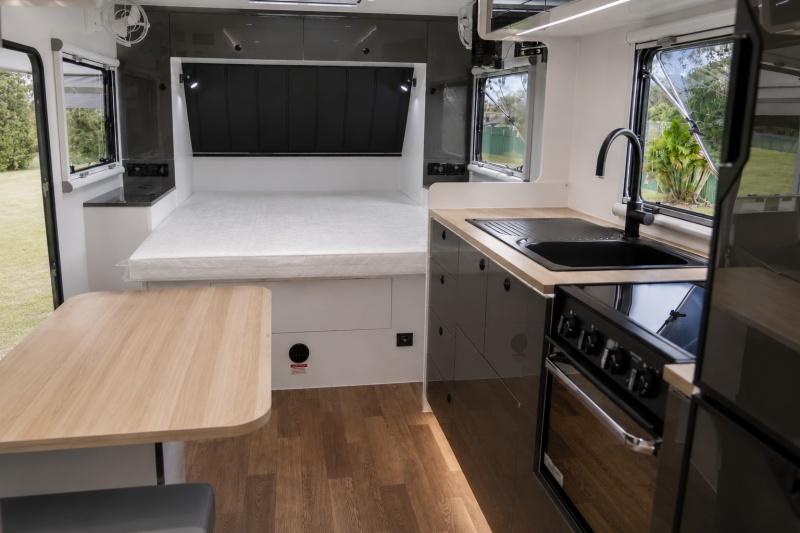
Interior layout
Sleeping configuration
Electrical system
Battery capacity
Solar capacity
Water tanks
Appliances
Suspension
Wheels and tyres
Exterior accessories
These options allow an importer to develop a caravan suited to its target market.
However, greater customization also creates greater production complexity.
A common misconception is that creating a dealer brand requires designing an entirely new caravan.
For many importers, this is unnecessary.
An existing manufacturing platform can provide the basic:
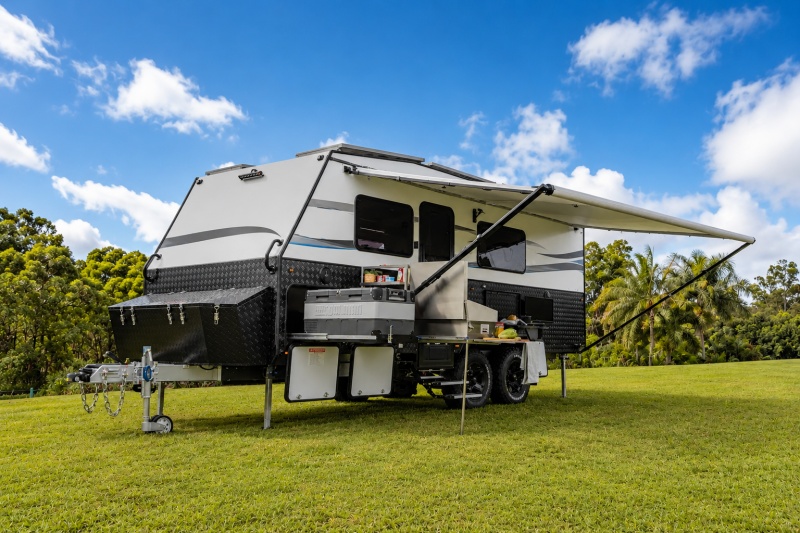
Chassis
Body
Dimensions
Interior structure
Plumbing architecture
Electrical architecture
The dealer can then select the features that actually differentiate the product in its local market.
This approach can reduce development time while making repeat production easier.
Before discussing colours or logos, the importer should define who will buy the caravan.
For example:
Couples Touring Model
May prioritize:
Permanent bed
Comfortable seating
Storage
Moderate water capacity
Balanced electrical system
Family Model
May require:
Additional sleeping capacity
Bunk beds
Greater storage
Larger water capacity
Additional charging points
Off-Grid Model
May place greater emphasis on:
Lithium batteries
Solar capacity
Inverter
Water storage
Remote-travel equipment
The customer profile should determine the OEM specification—not the number of options available from the factory.
Dealers should avoid creating several caravans that compete with each other.
A product range might be structured around:
Compact Model
Smaller platform for couples and buyers prioritizing manageable dimensions.
Mid-Size Touring Model
More interior space with a broader equipment package.
Family Model
Additional sleeping capacity, storage and living space.
The exact caravan lengths can then be selected according to the dealer's market.
This creates a more coherent product range than simply importing every available factory size.
Private-label requirements should be confirmed before manufacturing begins.
Depending on the project, branding may include:
Exterior logo
Decals
Model names
Interior branding
Identification labels
Manuals
Packaging
Dealers should also consider whether model names will remain consistent across future production.
Changing branding after a shipment has been completed can create unnecessary cost and work.
One of the most important decisions in an OEM program is deciding what not to customize.
For example, a dealer may standardize:
Selected water pumps
Switches
Lighting
Plumbing components
Interior hardware
Electrical equipment
where technically appropriate.
This can make future:
Spare-parts stocking
Technician training
Warranty diagnosis
Repeat ordering
considerably easier.
Suppose the same dealer model is produced with three different water pumps, four different inverters and several different lighting systems.
The customer may not notice the difference when buying the caravan.
The dealer will notice it when providing service.
Before ordering a replacement component, the dealer first needs to determine exactly which version was installed in that customer's unit.
This is why component consistency has commercial value.
Dealers can simplify OEM purchasing by defining repeatable packages.
For example:
A balanced specification for mainstream caravan customers.
May add:
Increased battery capacity
Additional solar
Larger inverter
Greater water capacity
May add selected:
Appliances
Interior upgrades
Comfort equipment
Exterior accessories
This gives customers meaningful choices without creating dozens of technically different caravans.
OEM electrical specifications should not be created by independently selecting the largest available battery and solar numbers.
Dealers should consider:
Expected daily consumption
Battery storage
Solar generation
Vehicle charging
Mains charging
Inverter capacity
The appropriate system depends on how customers are expected to use the caravan.
A family caravan with multiple electrical loads may require a different configuration from a compact touring model.
Water capacity can also differentiate dealer models.
Customers planning longer remote trips may value larger freshwater capacity.
However:
approximately 1 litre of water has a mass of 1 kilogram.
Therefore, increasing water capacity affects the caravan's loaded mass and potentially its weight distribution.
Water should be specified according to real customer requirements rather than simply maximizing tank size.
Appliances can strongly influence how customers perceive a caravan.
Depending on the model, these may include:
Refrigerator
Air conditioner
Cooking equipment
Hot-water equipment
Ventilation
Entertainment equipment
But dealers should also consider:
Replacement availability
Serviceability
Power consumption
Documentation
Local market suitability
A component that looks impressive in a specification sheet can become an after-sales burden if replacements are difficult to obtain.
Not every replacement part needs to come from the original factory.
Where technically appropriate, using components with practical local replacement options can reduce:
Shipping time
Customer downtime
Dealer spare-parts inventory
During OEM development, importers should therefore ask which components are factory-specific and which can reasonably be replaced locally.
Customization is not weight-neutral.
Adding:
Larger batteries
More solar equipment
Additional water tanks
Air conditioning
Extra spare wheels
Larger appliances
Additional furniture
can increase the finished caravan mass.
Dealers should evaluate the complete final specification, rather than relying only on the weight of a basic model.
The running configuration should be appropriate for the completed caravan.
Relevant considerations may include:
Final mass
Axle configuration
Intended terrain
Ground clearance
Wheels and tyres
A heavily upgraded OEM caravan should not automatically retain every specification from a lighter base configuration without technical consideration.
Once a dealer identifies a successful configuration, there is usually value in maintaining it.
Constantly changing:
Layout
Appliances
Batteries
Hardware
Interior materials
Electrical equipment
makes the dealer's product more difficult to manage.
Improvements are sometimes necessary, but they should be deliberate.
A mature OEM program should gradually move toward controlled product revisions rather than continuous random customization.
Supply-chain changes are sometimes unavoidable.
A component may:
Become unavailable
Be discontinued
Increase significantly in cost
Be replaced by a newer version
When a major component must change, the dealer should understand whether the replacement affects:
Performance
Appearance
Installation
Spare parts
Customer documentation
This is particularly important for repeat wholesale orders.
An initial dealer order is not only inventory.
It can also establish the reference specification for future production.
The dealer and manufacturer can confirm:
Model
Layout
Components
Equipment package
Branding
Finish
Options
Future orders can then refer back to the approved configuration.
This is much more efficient than rebuilding the specification from the beginning every time.
Before shipment, inspection should confirm not only general workmanship but also whether the dealer's approved configuration has actually been produced.
Checks may include:
Exterior branding
Interior layout
Battery system
Solar equipment
Water system
Appliances
Suspension
Wheels and tyres
Ordered accessories
For private-label caravans, specification conformity is part of brand consistency.
When only one caravan has been imported, the dealer may know its specification from memory.
That becomes impossible as the installed customer base grows.
Dealers can benefit from maintaining records covering:
Model
Production configuration
Major components
Spare parts
Product revisions
This makes future technical support easier.
Destination-market requirements can affect the caravan specification.
Depending on the country, dealers may need to consider requirements relating to:
Dimensions
Weight
Braking
Lighting
Coupling
Electrical systems
Gas equipment
Registration
The importer should confirm applicable local requirements before final production.
Customization should not be completed first and compliance investigated afterwards.
OEM can be particularly useful when a dealer:
Already understands its local customers
Wants to build its own brand
Plans repeat purchasing
Wants standardized models
Needs market-specific configurations
Has an after-sales strategy
For a business purchasing occasional individual units, extensive customization may provide less commercial benefit.
Before developing a private-label range, dealers should ask:
Which existing caravan platforms are available?
What can be customized?
What should remain standardized?
Can our own brand be used?
Can model names be customized?
Can equipment packages be standardized?
Which components are normally used?
How are component substitutions handled?
Can the approved specification be reproduced?
What spare parts can be supplied?
What technical documentation is available?
What quality-control process is used?
What purchasing quantity is required for the intended customization?
What production lead time should be expected?
These questions help determine whether the supplier can support a genuine dealer program rather than simply produce one customized caravan.
LZM works with international caravan dealers, importers and distributors requiring OEM and private-label caravan supply.
Businesses evaluating an OEM Off Road Caravan Manufacturer can review LZM's caravan range and discuss suitable platforms for their target customers.
OEM discussions can cover areas such as:
Dealer branding
Caravan size
Interior configuration
Electrical equipment
Battery and solar systems
Water systems
Selected appliances
Market-specific requirements
The objective is to develop a specification that can support repeat dealer purchasing, rather than treating every production unit as a completely new project.
For dealers planning their own caravan brand, useful information includes:
Destination country
Existing business
Target customer groups
Preferred caravan sizes
Required layouts
Equipment level
Branding requirements
Initial purchasing quantity
Expected annual volume
With this information, suitable existing platforms can be evaluated before deciding how much OEM customization is commercially necessary.
OEM caravan manufacturing should provide more than a dealer logo on the exterior.
A successful private-label program requires a balance between market differentiation and manufacturing standardization.
Dealers need enough customization to create a recognizable local product, while maintaining enough consistency to control production, spare parts, warranty service and future repeat orders.
For importers building a long-term caravan brand, the strongest OEM strategy is often not to customize everything.
It is to standardize the right things and customize the things customers actually value.