Welcome: Laizhou Machinery Group


One of the first decisions an off road caravan importer faces is how much customization is actually necessary.
A factory may already have established caravan models, while the dealer may want to change the layout, equipment, branding or technical specification for its local market.
This creates an important purchasing decision:
Should the dealer start with a standard factory model, or develop a more heavily customized OEM caravan?
There is no universal answer.
For dealers, the correct choice depends on factors such as:
Target customer
Purchasing quantity
Local competition
Required product differentiation
Compliance requirements
Development budget
Spare-parts strategy
Expected repeat-order volume
Understanding the trade-offs can prevent unnecessary development cost and production complexity.
A standard model is based primarily on an existing factory platform.
It may already have an established:
Body size
Chassis configuration
Interior structure
Sleeping layout
Kitchen
Bathroom
Electrical architecture
Plumbing arrangement
This does not necessarily mean the dealer cannot make any changes.
A standard platform may still allow selected options such as:
Exterior colour
Upholstery
Battery capacity
Solar capacity
Appliances
Dealer logo
The important distinction is that the underlying caravan remains close to an existing production model.
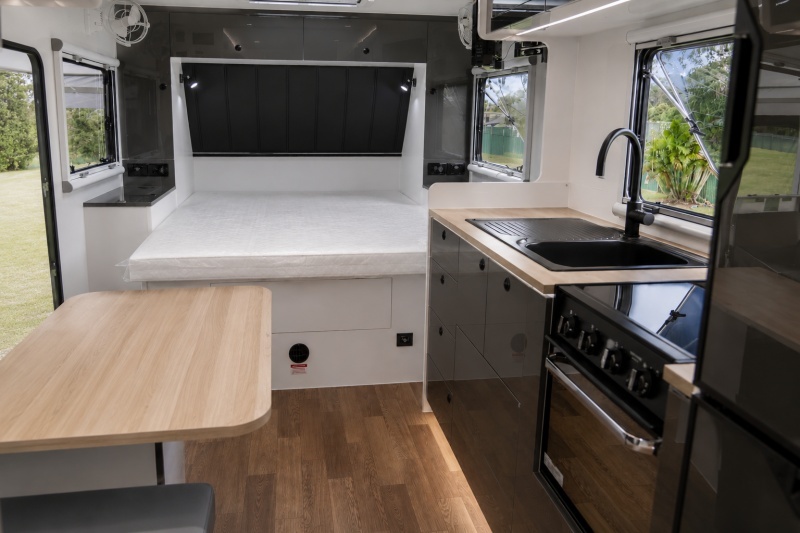
A custom OEM project involves more substantial changes according to the dealer's requirements.
Depending on the project, customization might involve:
Interior layout
Number of berths
Kitchen arrangement
Bathroom configuration
Storage
Electrical system
Water system
Suspension
Equipment packages
Exterior design
Private-label branding
The greater the changes, the more engineering and production coordination may be required.
For a new importer, beginning with an existing platform can have several advantages.
The factory may already be familiar with:
Production procedures
Material requirements
Component installation
Assembly sequence
Quality-control points
This can reduce the number of new decisions required for the first order.
For dealers testing a new market, simplicity can be valuable.
The opposite argument is equally important.
If several competitors sell similar caravans, a dealer may need stronger differentiation.
Customization can help create differences in:
Layout
Equipment
Appearance
Off-grid capability
Customer positioning
Brand identity
The key is to customize features that customers can actually understand and value.
Changing something simply because it can be changed does not necessarily create a better commercial product.
A dealer wanting its own caravan brand does not necessarily need a completely new vehicle.
Private-label changes can potentially include:
Dealer logo
Exterior decals
Model name
Interior branding
Selected colours
This can establish a local brand identity while keeping the underlying manufacturing platform relatively standardized.
For many distributors, this can be a practical starting point.
Changing a logo is relatively simple.
Changing the interior layout can affect multiple systems.
For example, moving a bathroom may influence:
Plumbing
Water tanks
Drainage
Electrical routing
Furniture
Weight distribution
Moving a kitchen may affect:
Water lines
Electrical equipment
Appliances
Ventilation
Storage
Dealers should therefore distinguish between cosmetic customization and structural or systems-level customization.
They are not equivalent from a manufacturing perspective.
A standard caravan can generally move toward production more quickly because fewer elements need to be redefined.
A heavily customized project may require additional time for:
Requirement confirmation
Layout development
Component selection
Technical review
Drawings
Production preparation
This does not mean customization should be avoided.
It means dealers should include development time in their purchasing plan.
This is particularly important for B2B buyers.
A manufacturer may be willing to make certain changes for a small order while other changes only become commercially practical at higher quantities.
Why?
Because custom production may require:
Special materials
Unique components
New tooling
Engineering work
Different production procedures
Dealers should therefore discuss MOQ together with the requested customization, rather than assuming one MOQ applies to every OEM project.
A heavily customized caravan may cost more for reasons beyond simply using better equipment.
Small-volume custom components can increase:
Material cost
Procurement cost
Engineering work
Production complexity
Dealers should determine whether the additional cost creates enough retail value.
If customers will not pay more for the change, the customization may not be commercially worthwhile.
This is one of the most important principles for dealers.
Suppose the first batch sells successfully.
Can the dealer order exactly the same specification again?
A custom model becomes much more useful when it can become a repeatable dealer product.
Before finalizing the first order, consider:
Which components must remain unchanged?
Which options can vary?
Which materials need to be recorded?
Which specification will define the model?
The first production batch should establish a foundation for the second.
Every unique component creates another item the dealer may eventually need to support.
If a custom caravan uses unusual:
Switches
Pumps
Lights
Hardware
Electrical equipment
Plumbing fittings
the dealer may need to stock those exact parts.
A highly customized caravan therefore needs a stronger spare-parts strategy.
This is one reason component standardization is valuable.
For service components, dealers should consider whether replacements can be obtained in the destination market.
Where technically suitable, locally available components can help reduce:
Spare-parts inventory
International freight
Customer downtime
For other factory-specific components, the dealer may need to keep replacement stock.
This question should be considered during product development—not after the first warranty problem.
Electrical packages are a common area of OEM customization.
A dealer may request:
Larger lithium batteries
Additional solar panels
Higher inverter capacity
More charging outlets
Additional appliances
But the correct electrical specification should be based on expected consumption.
A useful design process considers:
customer loads → required battery capacity → charging methods → solar capacity → inverter requirement
rather than selecting each component independently.
Larger freshwater tanks can be attractive for remote travel.
However, water has significant mass.
Approximately:
100 litres of water ≈ 100 kg
when full.
Increasing water capacity therefore affects:
Loaded mass
Payload
Weight distribution
Tank mounting requirements
Dealers should avoid treating water capacity as a marketing number without considering the complete caravan.
Changing interior equipment can move significant mass around the caravan.
Heavy items can include:
Batteries
Water tanks
Appliances
Spare wheels
Furniture
Therefore, extensive layout changes should not be considered purely from an interior-design perspective.
The complete caravan configuration matters.
Repeat production becomes easier when the factory repeatedly builds the same configuration.
This does not guarantee quality, but it reduces unnecessary variation.
For a dealer, a standardized model can make it easier to establish:
Inspection checklist
Product documentation
Spare-parts list
Sales specification
Staff training
As volume increases, these operational advantages become increasingly important.
Dealers do not necessarily have to choose between:
100% factory standard
and
100% custom design.
A practical middle path is:
Existing manufacturing platform + selected dealer customization.
For example, retain the established:
Body
Chassis
Basic layout
Plumbing architecture
while customizing:
Branding
Interior finish
Battery package
Solar package
Selected appliances
Market-relevant options
This provides differentiation without unnecessarily redesigning the complete caravan.
Another approach is to keep the caravan platform consistent while changing equipment levels.
For example:
Focused on core equipment and competitive retail pricing.
Adds selected comfort and interior upgrades.
Adds appropriate battery, solar, water and remote-travel equipment.
This gives dealers multiple retail positions without maintaining completely different caravan designs.
A dealer entering the caravan business may not yet know exactly what local customers will buy.
In that situation, extensive customization creates additional risk.
The dealer may spend money developing a feature that customers do not value.
An established platform with controlled customization can allow the importer to gather:
Customer feedback
Sales data
Dealer feedback
Service experience
Future production can then be refined based on actual market information.
An experienced dealer may already know:
Which layouts sell
Which appliances customers prefer
Which options generate profit
Which components create warranty problems
Which features competitors lack
That information can make OEM customization much more targeted.
Instead of guessing what customers want, the dealer can provide the manufacturer with specific product-development requirements.
Some customization is not about marketing.
Destination-market requirements may affect:
Electrical equipment
Braking
Lighting
Coupling
Dimensions
Weight
Gas equipment
Registration-related specifications
These requirements should be identified before production.
A standard export model should never automatically be assumed to satisfy every destination market.
Dealers should consider:
What problem does the customization solve?
Will customers recognize its value?
Does it improve our competitive position?
Does it affect production MOQ?
Does it increase lead time?
Does it require unique spare parts?
Can the same specification be reproduced?
Can replacement components be sourced locally?
Does it affect caravan weight?
Does it affect local compliance?
Will we order the same configuration again?
If these questions do not have clear answers, the proposed customization may need further evaluation.
A standard or lightly customized platform may be appropriate when:
The dealer is testing the market
Initial purchasing volume is limited
Fast product introduction is important
The existing layout already fits the customer
Price competitiveness matters
The dealer wants simpler after-sales support
Standard does not necessarily mean low quality or generic.
It means using an established production platform efficiently.
Greater customization may make sense when:
The dealer has a clear customer profile
Repeat purchasing is expected
The local market requires specific equipment
Competitor differentiation is important
Private-label development is a strategic objective
The dealer can support the resulting product complexity
In these situations, OEM development can help create a stronger proprietary product range.
LZM provides different caravan platforms for international wholesale and dealer projects.
Importers can first review the Off Road Caravan Manufacturer Range before deciding whether an existing model, a lightly customized configuration or a more extensive OEM project is appropriate.
Starting from the intended customer and commercial positioning can help avoid unnecessary customization.
When contacting LZM about an OEM caravan project, useful information includes:
Destination country
Existing caravan business
Target customers
Preferred caravan size
Required sleeping capacity
Standard features
Required customization
Dealer branding
Target equipment level
Initial purchasing quantity
Expected annual volume
This makes it easier to separate essential market requirements from optional changes.
For caravan dealers, more customization is not automatically better.
Standard factory platforms can provide advantages in cost, lead time, production consistency and after-sales management.
Custom OEM development can provide stronger differentiation, private branding and market-specific features.
The strongest dealer strategy is often somewhere between the two:
start with a proven manufacturing platform, standardize the core product and customize the features that genuinely help sell the caravan.
That creates a product that is not only different enough to compete, but also practical enough to manufacture, reorder and support over the long term.