Welcome: Laizhou Machinery Group



For an off road caravan dealer, the first order is important—but the second, third and fifth orders often reveal whether the supplier relationship actually works.
A dealer does not only need caravans to place in a showroom.
The business needs a supply system capable of supporting:
Repeat orders
Multiple models
Consistent specifications
Dealer branding
Spare parts
Product updates
Technical communication
Long-term customer service
This makes the requirements of a caravan dealer or distributor fundamentally different from those of an individual retail buyer.
When evaluating an off road caravan supplier, dealers should therefore consider not only the first purchase price, but whether the supplier can support the development of a sustainable local product range.
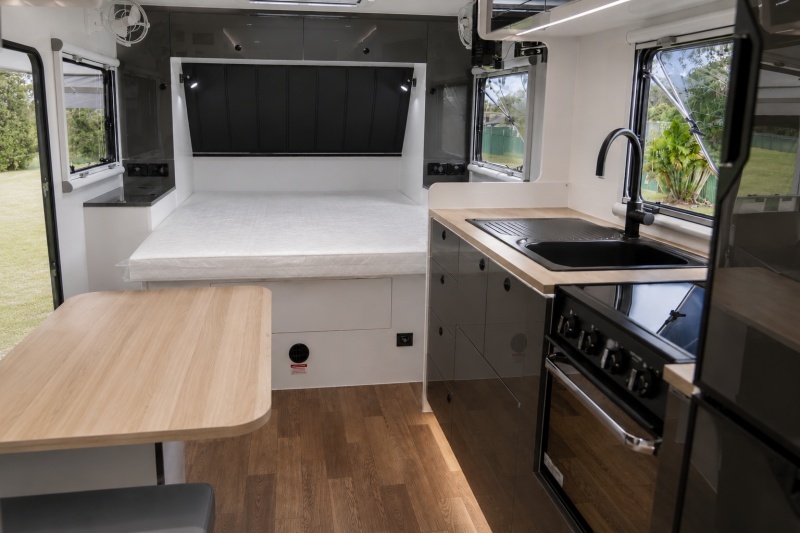
A well-built sample is useful.
But one successful caravan does not automatically prove that a manufacturer is suitable for a distribution program.
Suppose the first model sells successfully.
The dealer may then need:
Another batch of the same model
A smaller caravan
A larger family caravan
A different equipment level
Replacement parts
Updated marketing specifications
The real B2B question becomes:
Can the supplier continue supporting the dealer after the first shipment?
Importers do not necessarily need to purchase every model a manufacturer offers.
A more focused range can be easier to sell and support.
For example, a dealer might initially establish:
Compact Model
Designed for couples or buyers prioritizing smaller dimensions.
Mid-Size Touring Model
Provides additional living space and equipment while maintaining a clear price position.
Family Model
Designed around additional sleeping capacity, storage and longer trips.
Each model should have a defined customer rather than simply a different body length.
A dealer may be tempted to offer:
12ft, 13ft, 15ft, 16ft, 17ft, 19ft and 21ft caravans simultaneously.
More choice sounds attractive.
But if several models serve nearly identical customers, the dealer may create unnecessary:
Inventory
Marketing complexity
Spare-parts requirements
Staff training
Customer confusion
For an initial wholesale program, three clearly differentiated models can sometimes be commercially stronger than seven overlapping models.
The first production specification should ideally become a reference for future orders.
That means recording the agreed:
Layout
Exterior finish
Interior materials
Battery system
Solar system
Water system
Appliances
Suspension
Wheels and tyres
Dealer branding
If the model performs well, the next batch should not require the entire specification to be rebuilt from the beginning.
Repeatability is one of the most important differences between retail customization and dealer supply.
Imagine a dealer sells 30 caravans under the same model name.
If those caravans contain several different:
Inverters
Water pumps
Lighting systems
Switches
Plumbing components
after-sales support becomes more complicated.
When a customer contacts the workshop, the dealer first needs to identify exactly which version was installed.
For a distributor, product consistency therefore has operational value.
No manufacturer can guarantee that every component will remain available forever.
Suppliers may discontinue products, upgrade models or experience availability problems.
The important issue is how these changes are managed.
For major components, dealers should understand:
What is changing?
Why is it changing?
Does performance change?
Does installation change?
Will spare parts change?
Does the dealer need to update customer documentation?
Controlled product changes are easier to manage than unexpected substitutions.
Dealers naturally care about purchase price because it directly affects retail margin.
However, comparing two quotations only by total price can be misleading.
One caravan may include:
Larger batteries
More solar
Different suspension
Larger water tanks
More expensive appliances
Additional accessories
while another quotation does not.
A useful comparison therefore requires an equivalent specification.
The cheapest quotation is not necessarily the lowest-cost product to distribute over several years.
The factory price is only one part of an importer's cost.
Depending on the destination, landed cost may also involve:
Inland transport
Export handling
Ocean freight
Port charges
Import duties or taxes
Local transport
Inspection
Compliance-related work
Dealers should therefore evaluate purchasing decisions according to the complete commercial picture.
A small difference in factory price may become relatively unimportant after logistics and local costs are included.
A new distributor and an established national dealer do not necessarily need the same purchasing strategy.
For a new market, the initial objective may be to:
Introduce the product
Collect customer feedback
Test pricing
Identify the best-selling layout
Understand after-sales requirements
As sales become more predictable, order quantities can increase and the model range can expand.
Buying too many configurations before local demand is understood can create slow-moving inventory.
An established factory model can provide a practical starting point for an importer.
The dealer may only need to confirm:
Branding
Equipment package
Interior finish
Selected options
Destination-market requirements
This can be simpler than developing a completely new caravan before the dealer has collected local sales data.
Once the market is better understood, more targeted OEM changes can be introduced.
An experienced dealer may already know that local customers consistently request:
A particular sleeping arrangement
More battery capacity
More solar
Different storage
Specific appliances
Different water capacity
Particular interior finishes
These are stronger reasons for OEM customization because they are based on actual customer demand.
The best dealer specification is not necessarily the caravan with the most options.
It is the caravan that fits a clearly identified customer group.
For private-label programs, branding may include:
Dealer logo
Model names
Exterior graphics
Interior branding
Product documentation
As the product range expands, consistent branding helps customers recognize the dealer's caravan family.
Dealers should therefore establish a naming and branding structure that can accommodate future models rather than redesigning the brand for every shipment.
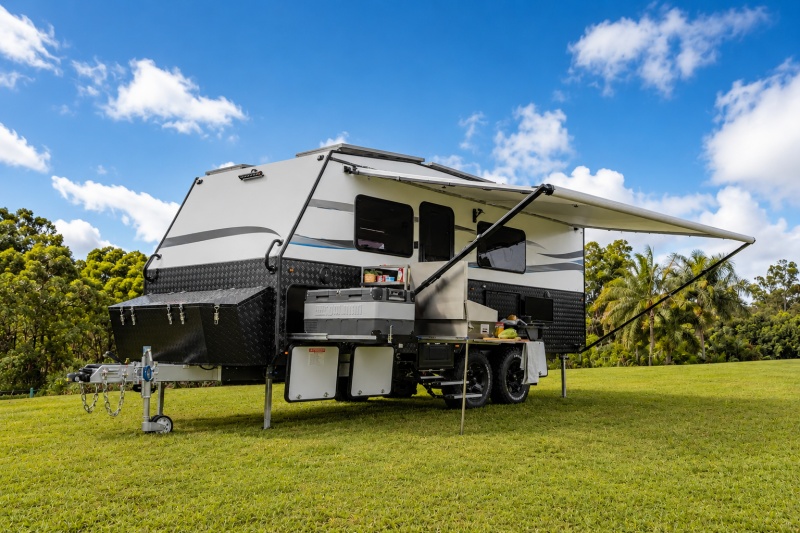
A caravan does not stop being the dealer's responsibility after it leaves the showroom.
Over time, customers may require replacement:
Pumps
Lights
Switches
Seals
Hardware
Electrical components
Plumbing components
For this reason, spare-parts planning should begin during purchasing.
The dealer should identify:
Which parts can be sourced locally?
and
Which parts should be supplied or stocked from the manufacturer?
For repeat orders, dealers may consider keeping a practical stock of frequently required service components.
The exact parts depend on the caravan specification.
The objective is not to import every component installed in the caravan.
It is to identify items where having local stock can reduce:
Customer waiting time
International shipping cost
Workshop delays
As the installed customer base grows, this becomes increasingly valuable.
A distributor may eventually need to diagnose:
Electrical issues
Plumbing issues
Equipment problems
Installation questions
The supplier should therefore be able to communicate relevant technical information for the products it manufactures.
A beautiful sales brochure helps sell the caravan.
It does not replace technical support when the dealer's workshop needs to solve a problem.
Dealers should understand more than the advertised warranty period.
Important questions include:
What types of manufacturing defects are covered?
What evidence is required?
How are replacement parts handled?
Who communicates technical solutions?
What costs remain the dealer's responsibility?
These details should be discussed before the dealer has caravans distributed across a large geographic market.
As sales volume increases, relying on informal messages becomes increasingly difficult.
A dealer may benefit from organized records covering:
Model specification
Major components
Production changes
Spare parts
Warranty information
Technical information
Good documentation makes a wholesale relationship easier to scale.
Quality control should not be treated as a special activity performed only for the first sample.
For repeat dealer orders, inspection can follow a consistent checklist.
Depending on the specification, checks may cover:
Exterior
Interior
Electrical functions
Plumbing
Appliances
Running equipment
Dealer branding
Ordered options
The objective is to maintain consistency across production batches.
Caravan dimensions affect more than customer use.
They can also influence:
Shipping method
Freight cost
Loading arrangements
Inland transportation
For importers, logistics should therefore be considered when selecting the product range.
A model that is attractive at factory level may have a different commercial result once international transport is included.
Destination-market requirements vary.
Depending on the country, a dealer may need to investigate requirements involving:
Dimensions
Weight
Braking
Coupling
Lighting
Electrical systems
Gas equipment
Registration
These requirements should be identified before finalizing production.
A caravan being manufactured for export does not automatically mean that the same configuration is suitable for road registration in every country.
A dealer or distributor should ask:
Which caravan models are suitable for repeat wholesale orders?
What is the purchasing quantity for each model?
Can dealer branding be added?
What OEM changes are available?
Can the same specification be reproduced?
How are component changes managed?
What quality-control process is used?
What spare parts can be supplied?
Which parts can be sourced locally?
What technical support is available?
What warranty process applies?
What production lead time should be expected?
What shipping information can be provided?
Can additional models be introduced later?
These questions help determine whether a supplier can support a long-term dealer program rather than simply complete an initial transaction.
LZM supplies different caravan platforms for international B2B customers.
Caravan dealers, importers and distributors looking for an Off Road Caravan Supplier for Dealers can review the available LZM caravan range and discuss model selection according to their target customers.
Dealer projects can include discussions around:
Model selection
OEM branding
Equipment packages
Interior configuration
Electrical systems
Water systems
Repeat production
Spare-parts requirements
The objective is not simply to supply the first shipment, but to establish a product configuration that can support future dealer orders.
Businesses interested in wholesale cooperation can provide:
Country or sales territory
Existing caravan business
Current product range
Target customers
Preferred caravan sizes
Required equipment level
Branding requirements
Initial order quantity
Expected annual purchasing volume
This information helps determine which caravan platforms are appropriate for the dealer's market and how the range could develop over time.
A strong off road caravan supplier for dealers needs to support more than production.
For an importer or distributor, the complete relationship includes:
model selection → specification → production → quality control → shipping → spare parts → technical support → repeat orders
The first caravan proves that a product can be manufactured.
The next several production batches determine whether that product can become a sustainable part of the dealer's business.
For distributors building a long-term caravan range, repeatability, consistency and after-sales support can ultimately matter as much as the initial wholesale price.