Welcome: Laizhou Machinery Group



For an off road caravan dealer, sleeping capacity is more than an interior-layout specification.
It helps define:
Target customer
Caravan size
Interior space
Storage
Equipment requirements
Retail price
Position within the dealer's product range
Two caravans of similar length can serve very different customers depending on whether they are designed primarily as a 2 berth off road caravan or a 4 berth family caravan.
For importers developing a wholesale product range, the important question is not simply which configuration can accommodate more people.
It is:
Which berth configuration creates the clearest and most commercially useful product for the dealer's market?
A 2 berth caravan is primarily designed around two occupants.
This customer group may include:
Couples
Retired travellers
Long-distance touring customers
Buyers who prioritize interior comfort over maximum sleeping capacity
Because additional beds are not required, the available interior space can potentially be used for:
Larger main bed
More storage
Larger bathroom
More comfortable seating
Larger kitchen
Additional equipment
This can make a 2 berth caravan attractive even when the body size is relatively large.
Dealers should avoid assuming:
2 berth = entry-level compact caravan.
Some couples specifically want a larger caravan because they value:
More living space
Permanent bed
Larger bathroom
More storage
Longer-trip comfort
A larger 2 berth model can therefore occupy a premium position in the dealer's range.
Sleeping capacity and caravan size should be treated as two separate product decisions.
A 4 berth configuration is generally designed to accommodate four sleeping positions.
Depending on the layout, these may include:
Main bed + bunk beds
Main bed + convertible dinette
Other fixed or convertible sleeping arrangements
For dealers, 4 berth models can target:
Families with children
Small family groups
Customers who occasionally need additional sleeping capacity
However, adding two beds affects more than sleeping.
Four occupants also create greater requirements for:
Storage
Water
Charging
Seating
Food storage
Ventilation
A successful family caravan therefore needs to be designed as a four-person living system, not simply a two-person caravan with two extra beds.
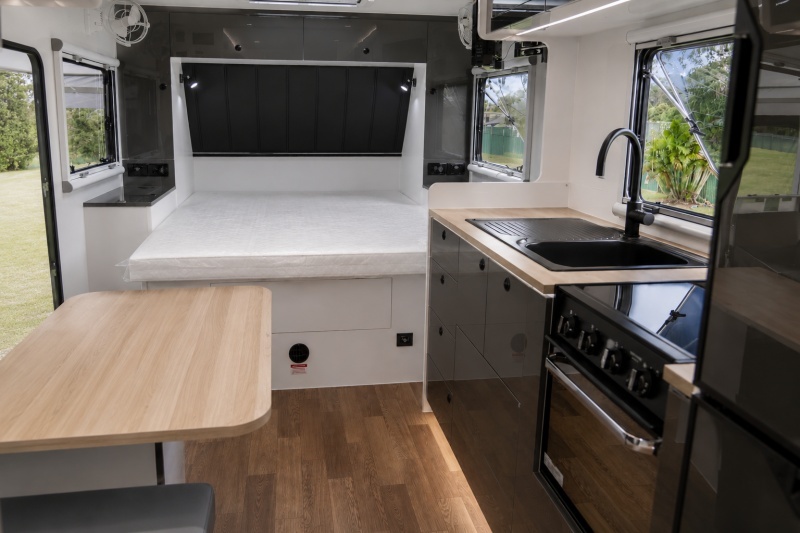
Bunk beds are one of the most obvious ways to differentiate a family caravan from a couples' model.
They can provide permanent sleeping positions without requiring the dining area to be converted every evening.
For a dealer showroom, bunk beds also communicate the target customer immediately:
This is the family model.
But bunk beds consume interior volume that could otherwise be used for:
Wardrobe space
Bathroom
Kitchen
General storage
The dealer therefore needs to decide whether permanent family sleeping capacity is worth the trade-off.
Another option is to use seating or dining areas as occasional sleeping spaces.
This can allow the caravan to maintain more open daytime space.
It may be appropriate for customers who:
Usually travel as a couple
Occasionally travel with children or guests
Do not require four permanent beds
This creates a different commercial proposition from a dedicated family bunk model.
Dealers should distinguish between:
true family 4 berth and 2 berth + occasional additional sleeping capacity.
Customers may perceive them very differently.
If a caravan is marketed for four people, dealers should also consider how those four people use the caravan during the day.
Questions include:
Can four people sit comfortably?
Is there sufficient dining space?
Are there enough charging points?
Is storage adequate?
Can people move through the caravan when beds are occupied?
A layout that technically sleeps four may still feel designed for only two occupants.
This is one of the easiest requirements to underestimate.
A family may carry:
Four people's clothing
Bedding
Shoes
Food
Children's equipment
Outdoor furniture
Camping gear
Personal electronics
Therefore, a 4 berth caravan needs more than additional beds.
It needs a storage strategy.
Useful areas may include:
Under-bed storage
Overhead cabinets
Wardrobes
Kitchen storage
External compartments
Physical storage capacity and payload are not the same thing.
A family can easily fill every available compartment.
The caravan may also already carry substantial mass from:
Batteries
Water
Solar equipment
Appliances
Spare wheels
Dealers should therefore evaluate family layouts together with the final weight configuration.
A caravan should not be marketed as having enormous storage without understanding how much load it can practically carry.
Four occupants generally consume more water than two.
Water may be required for:
Drinking
Cooking
Washing
Showering
This can make larger freshwater capacity attractive in a family model.
However:
1 litre of water has a mass of approximately 1 kilogram.
If a dealer increases capacity by 100 litres, the caravan can carry approximately another 100 kg when that additional capacity is full.
This needs to be considered in payload planning.
Four people may also use more:
Phones
Tablets
Lighting
Refrigerator capacity
Entertainment equipment
Water
Climate-control equipment
This does not automatically mean a 4 berth caravan needs the largest available battery bank.
It means the electrical specification should reflect the expected customer use.
Dealers should consider:
daily consumption + battery capacity + solar generation + other charging methods
as one system.
The number and location of USB or other appropriate charging points can affect customer experience.
In a 2 berth caravan, charging near the main bed and seating area may be sufficient.
In a family model, additional locations near:
Bunks
Dining area
Main sleeping area
may be useful.
These details are easier to plan during OEM production than to add after delivery.
A couple and a family can have different expectations for bathroom use.
A 4 berth caravan may benefit from:
More storage
Practical access
Appropriate ventilation
Adequate water planning
However, increasing bathroom size consumes interior space.
Dealers need to balance:
sleeping + bathroom + kitchen + storage + living space
within the same caravan body.
Food storage requirements may also increase with occupancy.
A dealer may therefore specify different refrigerator capacities between a couples' model and family model.
This can help create visible product differentiation.
But larger appliances can affect:
Purchase cost
Electrical consumption
Interior space
Weight
Again, the complete configuration matters.
A useful dealer strategy is not necessarily to position the 2 berth model below the 4 berth model.
Instead:
2 Berth Premium Touring
could focus on:
Larger main sleeping area
More storage
More comfortable bathroom
Larger seating area
Higher equipment level
while:
4 Berth Family Touring
could focus on:
Additional sleeping capacity
Family storage
Practical kitchen
Balanced equipment package
These two products can serve different customers without one automatically being "better."
Adding beds does not necessarily justify a large retail price increase.
Likewise, a 2 berth caravan with premium equipment may cost more than a basic 4 berth model.
Dealers should position price according to the complete package:
size + layout + equipment + customer value
rather than using berth count alone.
Possibly.
Offering both a 2 berth and 4 berth version of the same platform can allow a dealer to serve different customer groups without introducing another body size.
Potential advantages include:
Shared exterior platform
Similar marketing
Some common components
Simplified inventory structure
However, two layouts should only be offered if there is enough demand to justify both.
Otherwise, the additional SKU can complicate inventory unnecessarily.
Another strategy is to separate the products more clearly.
For example:
Smaller / Mid-Size Caravan
Primarily couples-oriented.
Larger Caravan
Primarily family-oriented.
This makes the product ladder easier for customers to understand.
The dealer can then use caravan length, sleeping capacity and equipment together to create clear model separation.
Consider a dealer offering:
17ft 2 berth
17ft 4 berth
19ft 2 berth
19ft 4 berth
21ft 2 berth
21ft 4 berth
That is already six configurations before considering equipment packages.
Add Standard / Premium / Off-Grid versions and inventory complexity increases quickly.
For many importers, a better strategy is to select a smaller number of combinations with clear commercial roles.
A new dealer could initially select models such as:
Couples Touring Model
One size and one defined 2 berth specification.
Family Touring Model
One size and one defined 4 berth specification.
Customer feedback and actual sales data can then determine whether additional configurations are necessary.
This is often more useful than trying to predict every possible customer preference before entering the market.
The same manufacturing platform can potentially be configured differently for dealer programs.
A couples-oriented model might prioritize:
Main bed
Seating
Bathroom
Storage
A family model might prioritize:
Bunks
Additional storage
Charging points
Water capacity
Family-friendly layout
Customization should strengthen the model's target customer rather than simply increase the option list.
Where technically appropriate, dealers can use common components across multiple models.
Examples may include selected:
Lighting
Switches
Pumps
Electrical components
Interior hardware
Materials
This can simplify:
Spare-parts inventory
Technician training
Purchasing
Warranty support
Different layouts do not require every component to be different.
Dealers should compare the actual finished configurations.
A 4 berth model may add:
Bunk structure
Additional storage
Larger water system
Additional equipment
A premium 2 berth model may add:
Larger batteries
More appliances
Additional comfort equipment
Therefore, berth count alone does not determine weight.
The final production specification should be evaluated as a complete system.
Product differentiation needs to be obvious to customers.
When someone enters the 2 berth model, the dealer should be able to explain:
This model is optimized for couples and longer touring comfort.
When the customer enters the 4 berth model:
This model is designed around family sleeping and storage requirements.
If the salesperson cannot clearly explain why both models exist, the product range may need further refinement.
Before ordering, consider:
Who is the target customer?
How many people normally travel together?
Are permanent bunks required?
Is convertible sleeping acceptable?
Is daytime seating adequate?
How much storage is required?
What water capacity is appropriate?
What battery system is required?
Does refrigerator capacity need to increase?
Are enough charging locations provided?
How does the layout affect payload?
Should both layouts use the same caravan platform?
Do we need both configurations in inventory?
Can components be standardized?
What retail price position should each model occupy?
These questions help turn berth count into a commercial product decision.
LZM works with international dealers and importers requiring different caravan sizes, layouts and equipment packages.
Businesses developing a couples or family product range can review the Off Road Caravan Manufacturer Range and compare available platforms for their target customers.
Dealer discussions can include:
Caravan size
Sleeping configuration
Interior layout
Storage
Battery and solar
Water system
Equipment packages
OEM branding
For dealers wanting to show customers a larger family-oriented platform with more interior and product imagery, the LZM 21ft Family Off Road Caravan provides another reference point when evaluating larger caravan configurations.
Dealers can then continue through the broader LZM range to compare other sizes and layouts rather than treating 21ft as the only available model.
When requesting a quotation, dealers can provide:
Destination market
Existing caravan business
Target customer
Required caravan size
2 berth or 4 berth requirement
Preferred sleeping layout
Equipment package
OEM branding
Initial purchasing quantity
Expected annual volume
This allows the discussion to begin with the commercial role of the caravan rather than simply selecting options from a list.
For dealers, choosing between a 2 berth and 4 berth off road caravan is not simply a question of sleeping capacity.
The decision affects:
customer positioning, layout, storage, water, electrical demand, payload, equipment and retail pricing.
A strong dealer range may include both—but only when each model has a clear reason to exist.
The objective is not to offer every possible combination.
It is to create a small number of clearly differentiated, repeatable caravan models that customers can easily understand and dealers can efficiently stock, sell and support.