Welcome: Laizhou Machinery Group



When an event company needs temporary indoor space, the traditional answer is often simple:
Install a tent.
Event tents are widely available, can cover large areas and can be configured for weddings, festivals, corporate functions and hospitality events.
But another type of temporary venue is increasingly relevant for operators that need a more permanent-quality indoor environment:
the expandable event trailer.
An expandable event trailer travels in a compact transport configuration and deploys at the destination to create a substantially larger enclosed space.
So which is the better investment?
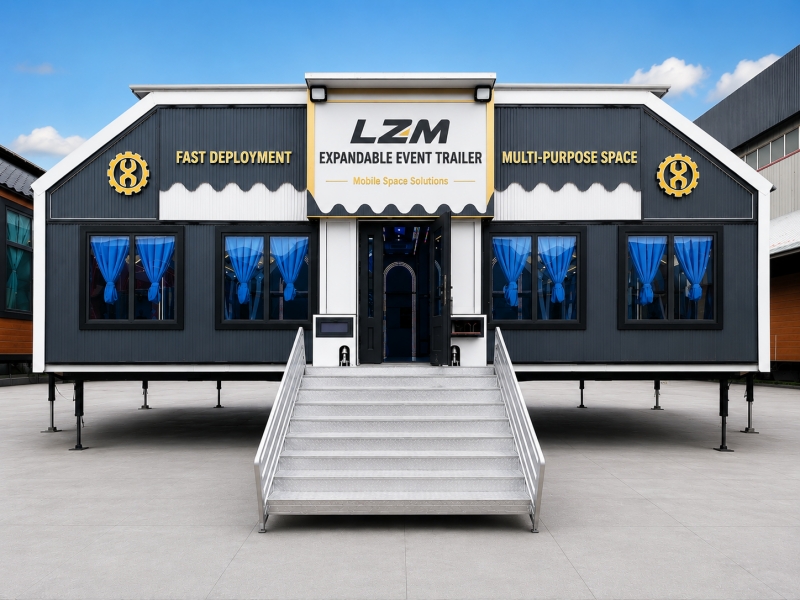
Expandable event trailer or traditional event tent?
There is no universal winner.
The correct choice depends on how frequently the venue will be used, the type of customers being served, expected interior quality, transportation, site conditions and the operator's business model.
An event tent is essentially a temporary structure assembled at the event location.
An expandable event trailer is a transportable engineered structure that carries much of the venue with it.
That creates two very different operating models.
Transport components → Assemble structure → Install interior → Hold event → Dismantle → Transport components
Transport trailer → Position → Expand → Connect utilities → Prepare interior → Hold event → Retract → Relocate
Neither model is automatically better.
But the difference affects almost every aspect of commercial operation.
If the requirement is simply:
Create a very large covered area at the lowest practical structural cost
a tent can be difficult to beat.
Tent systems can be extended to create large footprints for:
Festivals
Large weddings
Exhibitions
Temporary dining
Public events
Sports hospitality
For extremely large temporary venues, modular tent systems may provide substantially greater capacity than a single expandable trailer.
This is important.
An expandable event trailer should not be presented as a replacement for every tent application.
The strongest advantage of an expandable trailer is not unlimited size.
It is the ability to repeatedly deploy a more integrated indoor venue.
The structure can incorporate systems such as:
Finished walls
Finished flooring
Ceiling
HVAC
Lighting
Electrical distribution
LED displays
Doors and windows
Hydraulic expansion
Many of these systems remain part of the asset between events.
The operator is therefore transporting a significant portion of the venue itself.
When comparing setup time, buyers should look at the entire process.
A tent installation may involve:
Structural assembly
Anchoring or ballast
Flooring
Wall installation
Lighting
HVAC
Electrical distribution
Interior decoration
Furniture
An expandable trailer still needs:
Positioning
Support
Expansion
Utility connection
Furniture
Event-specific decoration
The actual difference depends on how sophisticated the event needs to be.
A basic tent may be quick and economical.
A high-end temporary ballroom can require much more work.
Consider a rental company operating one event.
Setup cost matters once.
Now consider a company operating the same venue dozens of times per year.
Every repeated operation requires:
Labor + Transport + Installation + Removal + Inspection
Over many bookings, setup efficiency becomes increasingly important.
This is where an integrated expandable venue can become commercially interesting.
The buyer should not compare only:
Tent purchase price vs trailer purchase price.
A better comparison is:
Total operating cost over the expected number of events.
A tent can be transformed into an impressive event venue.
High-quality temporary structures can include:
Premium flooring
Linings
Chandeliers
HVAC
Decorative walls
AV systems
But achieving that result usually requires additional fit-out.
An expandable event trailer can be manufactured with a finished interior that remains installed between events.
This may create a more consistent base environment.
For applications such as:
Luxury weddings
Corporate hospitality
VIP events
Brand activations
interior quality can directly influence the rental price.
Wedding customers rarely care how technically efficient the temporary structure is.
They care how the venue feels.
They notice:
Ceiling
Lighting
Flooring
Walls
Temperature
Acoustics
Entrance
Furniture
Decoration
A tent can absolutely deliver a premium wedding experience when professionally designed.
But an expandable venue offers another way to provide a finished enclosed environment without recreating the entire shell for every booking.
For a premium wedding operator, that consistency may have value.
Both tents and expandable structures can provide weather protection.
But the operating environment is different.
For outdoor events, buyers should consider:
Rain
Wind
Heat
Cold
Humidity
Dust
A temporary structure must be appropriately specified and installed for the applicable conditions.
An expandable venue provides a more building-like enclosed shell, but it also has its own engineering and operating limits.
Neither should be used outside its designed conditions.
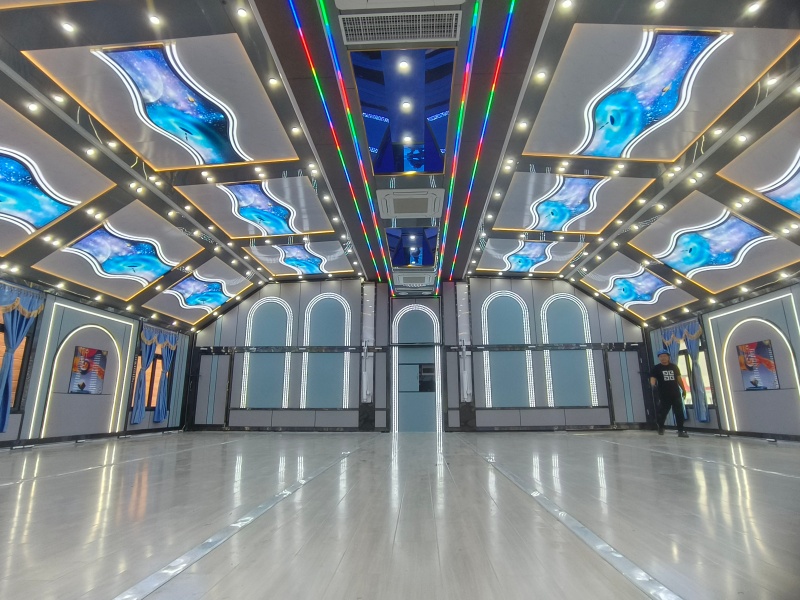
Climate control can be one of the most important differences for high-value events.
A commercial event may contain:
100+ Guests + Lighting + Screens + Catering Activity
all generating heat.
With an expandable trailer, HVAC can be incorporated into the original project design.
The manufacturer can consider:
Interior volume
Guest capacity
Destination climate
Electrical supply
Equipment loads
This creates a repeatable HVAC configuration.
Tent HVAC is also widely available, but equipment and ducting may need to be installed as part of the temporary event setup.
In markets with high temperatures, a beautiful temporary venue can become unusable if guests are uncomfortable.
This matters for:
Weddings
Corporate events
Hospitality
Exhibitions
Private functions
Buyers operating in hot regions should therefore compare temporary venue systems based not only on enclosed floor area, but on the ability to maintain suitable indoor conditions during realistic occupancy.
Cold environments require attention to:
Heating
Insulation
Air leakage
Door operation
Floor comfort
Again, neither “tent” nor “trailer” automatically answers these questions.
The buyer needs to evaluate the complete envelope and HVAC system.
The destination climate should be part of the procurement specification from the beginning.
Temporary event venues operate outdoors.
Wind conditions therefore matter.
Tent systems require appropriate engineering, installation and anchoring or ballast according to their design and local requirements.
Expandable trailers also need suitable positioning, support and operating conditions.
Buyers should obtain the relevant engineering information for their destination rather than assuming that any temporary venue can operate safely in all weather.
A flat paved site is very different from:
Grass
Sand
Soft soil
Sloping land
Gravel
Tent installation may require specific anchoring or ballast solutions.
An expandable trailer needs suitable access, positioning and support.
Before purchasing either system, an event rental company should study the types of sites it serves most frequently.
The best venue is useless if it cannot be deployed at the customer's location.
An expandable trailer needs road access.
It also needs enough room for:
Transport
Turning
Positioning
Deployment
Some event locations may have beautiful open spaces but difficult vehicle access.
Tent components can sometimes be transported into sites where positioning a large trailer would be difficult.
For rental companies serving remote wedding properties or restricted urban sites, this can be an important advantage of tents.
The opposite is also true.
If an operator repeatedly serves:
Hotels
Resorts
Exhibition sites
Sports venues
Commercial properties
Large wedding estates
with suitable vehicle access, the trailer model may become more practical.
The same deployment process can be repeated across familiar site types.
Tent operators need storage for:
Structural components
Fabric
Flooring
Linings
HVAC equipment
Lighting
Furniture
An expandable trailer stores much of its structural system as one mobile asset.
However, it still requires:
Parking/storage space
Maintenance access
Protection when unused
Furniture storage where applicable
Neither system eliminates storage requirements.
They simply organize them differently.
A tent may require trucks carrying:
Structure
Flooring
Furniture
HVAC
Decorations
An expandable trailer is itself a large transportable asset and may require an appropriate tractor and road-compliant configuration.
The correct comparison therefore depends on:
Event distance
Equipment volume
Number of vehicles
Labor
Fuel
Road requirements
For frequent long-distance operation, logistics can become a major part of profitability.
This is one of their clearest limitations.
A trailer can only expand to the size for which it was engineered.
A tent system can often be more modular.
If the event grows from 200 to 400 guests, a tent operator may be able to install a larger structure or add bays, depending on the system.
An expandable trailer cannot simply become twice as long.
This is why the expected booking market matters.
One solution is to use more than one compatible expandable unit.
Depending on the project design, multiple units can potentially create larger combined spaces.
This can offer another fleet model:
One Unit → Medium Event
Two Units → Larger Event
However, multi-unit connection should be engineered deliberately.
It should not be assumed that unrelated trailers can simply be parked together to create one compliant venue.
Another tent advantage is geometric flexibility.
Depending on the system, operators can create different:
Lengths
Widths
Extensions
Entrances
Connected areas
Expandable trailers have more defined geometry.
This makes them less flexible in overall shape but potentially more repeatable in setup.
Again, the business needs to decide which form of flexibility matters more.
For brand activation and promotional campaigns, an expandable trailer can become a recognizable mobile asset.
Exterior and interior surfaces can incorporate:
Brand graphics
Product displays
Digital screens
Lighting
Campaign equipment
A beverage company, automotive brand or experiential marketing agency may reuse the same branded platform across multiple events.
Tents can also be branded effectively, but the operating concept is different.
An event rental company serving many clients may not want permanent branding.
Instead, it can design the expandable venue around:
Neutral Base Interior + Changeable Branding
Graphics, screens, furniture and decoration can then change between bookings.
The same asset might support:
Wedding → Corporate Event → Brand Activation → VIP Hospitality
This can improve utilization.
Tent systems require inspection and maintenance of:
Fabric
Frames
Connectors
Flooring
Anchoring systems
Expandable trailers introduce another set of systems:
Hydraulic equipment
Hinges
Seals
Moving structures
Electrical systems
HVAC
Chassis components
An expandable trailer is therefore not maintenance-free.
Its greater mechanical integration creates maintenance requirements that operators need to understand.
Tent crews need specialized installation knowledge.
Expandable trailer crews need a different type of training.
Operators may need to understand:
Positioning
Leveling
Hydraulic operation
Expansion sequence
Electrical connection
HVAC
Retraction
Transport preparation
For a rental business, these procedures should be standardized.
Incorrect operation can create downtime or damage.
For many one-time temporary events, purchasing an expandable event trailer would make little economic sense.
A rented tent or temporary structure may be much more practical.
This is especially true when:
The event happens once
Very large floor area is required
Budget is limited
Long-term asset ownership has no value
Expandable trailers become more relevant when the buyer expects repeated commercial use.
This depends on the company's market.
A tent rental business serving everything from small parties to enormous festivals benefits from modularity and scale.
An expandable trailer can instead add a differentiated premium product to the fleet.
The company may offer:
Traditional Tent
for large flexible temporary coverage.
and
Expandable Event Venue
for customers wanting a more integrated premium indoor environment.
The two products do not necessarily compete.
They can serve different bookings.
An established wedding property with suitable access may value:
Finished interior
HVAC
Repeatable setup
Premium appearance
Long-term deployment
An expandable banquet hall may therefore be worth evaluating.
But a property that needs dramatically different venue sizes for every wedding may prefer the flexibility of tent systems.
The booking profile should determine the answer.
Brand activation often favors repeatability.
A campaign may visit:
City A → City B → City C → City D
with essentially the same customer experience.
An expandable trailer can be attractive because much of the:
Brand Environment + Screens + Lighting + Electrical Infrastructure
travels together.
For touring experiential marketing, this repeatability can be particularly valuable.
For very large temporary venues, tent systems often have a natural advantage because of their modular scale.
An expandable trailer may instead serve as one specialized component within the event, such as:
VIP hospitality
Sponsor activation
Media space
Premium lounge
Registration
Corporate suite
The correct comparison is therefore not always:
Trailer OR Tent?
Sometimes it is:
Where should each system be used within the same event?
A serious commercial comparison should consider several years of operation.
Possible cost categories include:
Initial purchase
Transportation
Setup labor
Dismantling labor
Storage
Maintenance
HVAC
Electricity
Repairs
Interior fit-out
Rebranding
Insurance
Expected service life
Then compare these costs with:
Rental rate
Number of bookings
Utilization
Customer segment
Revenue per event
This provides a much more useful investment analysis than comparing initial prices alone.
A more expensive asset can sometimes make sense if customers will pay substantially more to rent it.
Conversely, a premium venue that the local market refuses to pay for is a poor investment.
Rental companies should ask:
What can we realistically charge per booking?
Then:
How many bookings can we realistically win each year?
The answer determines whether the additional capital investment is justified.
An event tent may be more appropriate when the priority is:
Very large floor area
Modular size
Lower initial structural cost
One-time or occasional use
Difficult site access
Frequent changes in venue dimensions
An expandable event trailer may be worth considering when the priority is:
Repeated commercial deployment
Finished indoor environment
Integrated HVAC and electrical systems
Premium customer experience
Faster repeatable venue configuration
Touring campaigns
Long-term asset ownership
Some operators will benefit from owning both.
The most important question is not:
Which product looks better?
It is:
What kind of events will generate revenue from this asset?
A company serving 1,000-person festivals has different requirements from a wedding venue serving 150-person receptions.
An experiential agency running a 20-city brand campaign has different requirements again.
Start with:
Customer → Event Type → Capacity → Site → Frequency → Rental Rate
Then select the venue system.
An expandable event trailer is not a universal replacement for event tents.
And a tent is not automatically the best solution simply because temporary event structures have traditionally been built that way.
They solve different operational problems.
Tents excel at modular scale and flexible temporary coverage.
Expandable event trailers excel when operators need a repeatable, integrated and higher-finish mobile indoor venue.
For event rental companies, wedding venue operators and experiential marketing agencies, understanding that distinction is more important than deciding which product is universally “better.”
LZM manufactures expandable event trailers in multiple sizes with customizable interiors, HVAC, lighting, electrical systems, LED display provisions and commercial event layouts for repeated event and hospitality applications.
Compare expandable event trailer configurations for your commercial event business:
Expandable Event Trailer for Commercial Events